Saturday, July 10, 2010

Foreign Wife, Japanese Husband to Become E-book


The Foreign Wife, Japanese Husband portion of the Chirashi blog is undergoing a redesign in order to become an e-book! More details will be coming soon. In the meantime, if you're the foreign wife of a Japanese husband and would like to be interviewed for this project, write me at: info (AT) WendyTokunaga DOT COM. Yoroshiku onegai shiimasu.

Saturday, November 28, 2009

Love in Translation: Foreign Wife, Japanese Husband - Part 3


Patrice, originally from the United States, now lives in Japan with her Japanese husband Junya, who goes by the name of Jack. In this interview she speaks candidly about the challenges of being a gaijin in Japan, bringing back lots of memories for me!


Where and how did you meet your husband?
I met my husband in the United States while I was working as a translator/interpreter in the engineering department at a Japanese company in the mid-West. He had been sent over to work for a few years at the company's mid-West branch office.

He couldn't speak English well so he was often asking me for translation help. I was actually seeing someone else at the time, so Jack and I were just amicable office mates. I helped him with some private translation and he took me to dinner to show his appreciation. I found him to be a charming gentleman and extremely easy to talk to. I confided my personal problems with my current boyfriend to him and he listened patiently, then said in completely seriousness, "Break up with him and go out with me.”

Do you live together in Japan now?
Yes. And we lived together for about a year in States before getting married.

What are the challenges of living in Japan?
Ohhhhhhh jeez. Well, I had lived in Kyoto for three years on my own while working for the JET Program, so I had a pretty good idea what I was getting myself into. However, I quickly learned the differences between Kansai and Kanto since living in Saitama. Now, I've become practically numb to the challenges, so it is hard to recall what I find or found challenging.

Two weeks after we had our wedding in the States, I followed Jack back to Japan and at first I was horribly homesick. I also had some physical challenges adapting to the climate and environment. I felt exhausted all the time and suffered chronic muscular pain. Just going to the grocery store felt like a huge feat. Looking back, my particular challenges with living in Japan had nothing to do with our marriage per se; in fact being married to a Japanese man and living in Japan was far better than the years I spent single in Kyoto.

Some challenges I faced were loneliness, the inconvenient location we lived in, the apartment where we lived, the neighbors that lived above and next to us, failed friendships with Japanese women, cooking for two (if I was single, I could eat very simply and no one complained), getting used to driving on the “wrong” side of the road, frustration with the climate and its effect on me, and last but not least, the endless family obligations.

Had you ever envisioned that you might marry a person from another culture?
Yes. Definitely.

Do you and your husband speak Japanese to each other?
Yes. I throw in a few English words just for fun. My husband is very talented and smart in many areas, but acquiring languages is not one of his strong points. Somehow he still gets along with my family and friends with his broken English and the universal love for drink and food certainly helps.

Do you and your husband have any communication problems that have nothing to do with language?
No, we are very open and don't keep anything suppressed. He is very no- nonsense and doesn't hesitate to show his emotions. In other words there is no “double-speak” and the typical beat-around-the-bush guessing game is non-existent in this house.

Jack is from Tokyo's equivalent of the Bronx. His family is working class and they are not exactly what one would call cultured or intellectual. I don't mean that in a snobby way. In fact, I rather like it because I don't feel like I’m being judged, tested and evaluated all the time like I do with some other families I know here.

I know this may sound strange, but in a way I think it is good that we don't speak each other’s language perfectly. I understand Japanese better than he understands English and that is probably a good thing. Why? Because I can be very sarcastic and cutting, so it's probably better for our marriage that he doesn't understand my occasional barbs. When I watch TV from the States, I am often amazed at how mean couples can be with their words (in an argument) and I often think, thank God I don't have that aspect in my marriage. Words can be daggers.

What are some of the most challenging aspects of your cross-cultural marriage?
I would have to say the biggest challenge is tolerating his family. It's not that I don't like them (and my mother-in-law and I get along very well) but she seems overly dependent on my husband. The chonan, the oldest son of his family, has been living in the States for the past six years. He is finally being sent back to Japan, but this whole time Jack has had to pick up the chonan slack, which means all kinds of duty and obligations that sometimes overly complicate our lives, and can be rather nerve-wracking.

But to be fair, I should also explain that my mother-in-law is a widow and has never had to learn to do anything independently. She just has a middle school education and was never encouraged to pursue further studies. She was just expected to help the family and eventually get married, have children etc. Despite the fact that she was the only daughter out of four other sons, Jack’s father married into her family. This is unusual because normally when men are “adopted” by the bride's family, so to speak, it’s because the family has only daughters. So Jack’s mother never experienced having to be the wife/daughter-in-law in an unfamiliar household.

And also I must say that my mother-in-law has been kind to me in her own way. She doesn't complain about me and has accepted me completely, despite my being a gaijin. So, I have to give her credit for that. I know things could be a lot worse. For example, we don’t live with her and that helps.

Do you work outside the home? If so, what is your job?
I do. I work at a little company that provides translation services and conversation in English, Spanish, Chinese & Korean. I am the English translator/teacher obviously. I have “clients” for which I translate mostly business-related documents and then I have a few students. I had another job working as a public (government) translator/interpreter and I mostly worked for hospitals, public lawyers and government offices, but that job was so wracked with petty politics and twisted people that I just had to leave before it got the better of me. I did enjoy being a translator for hospitals though.

What attributes do you feel are most important for a successful cross-cultural marriage?
I know everyone says this, but a sense of humor and the ability to just go with the flow and not try to control things. It's taken me a while but now I have the attitude of, "OK, whatever, that's just the way it is." I feel like my husband and I get along because we are very compatible as living partners and we just click. If I'm the pot, he's the lid. Our "cross-cultural-ness" doesn't seem to play too much of a part in the whole thing.

What do you find frustrating about Japanese culture?
Body temperature. You're probably thinking, "What the hell? Body temperature?" Yes, Wendy. I’m serious.

Winter is the worst for me because every single store, office, restaurant, train, bus etc. is blasting the heat soooooo high, I just want to tear off my skin. It amazes me that winter is the only time I wear short sleeves and I wear long sleeves in the summer to protect my skin from sunburn. I complain about this every fall and winter, but everyone tells me, "Japanese have a very low body temperature and they are easily cold, unlike you, who has the body of a “hunter/gatherer meat eater.” Japanese will never complain about it being too hot, but they get very upset about cold. Also there are so many old people now and they must stay warm, which makes me want to shout things about scarves, hats, gloves and global warming. It does not need to be 82 degrees (F) in a tightly packed train. Ever hear of natural body heat?

That brings me to another frustration: the constant living under a microscope and being measured against Japanese (mis)conceptions about gaijin. I'm not just talking about the "You use chopsticks so well!” or “You can eat sushi?!?!" bits, I’m talking about the "We Japanese are originally peaceful farming people who live (lived) on a simple diet of rice, fish and vegetables. You, however, are a hunter/gatherer meat-eating (in other words barbarian) so....[fill in the blank with whatever reasoning.]" And whatever I do, even down to the tiniest thing, whatever I do is constantly "Gaijin dakara..." (because you’re a foreigner) or else "Nihon-jin mitai..." (like a Japanese) when whatever behavior I do is positive and satisfying in their eyes.

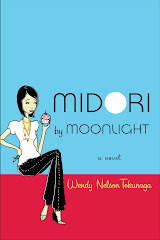
—Wendy Nelson Tokunaga conducted this interview. She is the author of the novels, Love in Translation and Midori by Moonlight. Get more info at: http://www.WendyTokunaga.com

Saturday, November 21, 2009

Love in Translation: Foreign Wife, Japanese Husband - Part 2

Laura Aoyama has lived in Gunma prefecture with her husband Yusuke and their two children for going on five years. I found the answers to her questions quite interesting (and relatable!) especially about her fascination and frustrations with Japanese culture, which as she so astutely states, “go hand in hand.”

Where and how did you meet your husband?

We met in Gunma where I was doing some temporary substitute English teaching. This was quite unusual, as I worked as a trainer in Tokyo, but it was a busy period, so all of my substitute teachers were busy. He came into the school as a prospective student.

Did you know anything about Japan or Japanese culture prior to meeting your husband?

I had lived in Japan for three years prior to meeting my husband, so yes. Although I knew little of Japan before moving here. I was born in the U.K., but lived a little in France, and 3 years in Germany before moving to Japan.

Had you ever envisioned that you might marry a person from another culture?

I thought it may happen, as I love traveling, and have spent most of my adult life living in countries other than my home country.

What are the challenges of living in Japan?

Wow, where do I start?!?! Firstly, living in a major city, and living in the countryside here are two very different prospects. Having lived in Tokyo for three years, I have to say that the comfort level is much higher than out here in Gunma. However, this is something that is the same in any country. I would say my biggest challenge is language, and cultural communication. As they say, language is only a very small part of communication, so once you get through the words, learning the hidden messages within the Japanese culture becomes a second challenge. Other than that, I have found since I became a wife and mother especially, social expectations are elevated.

What kind of social expectations do you face now?

I am expected to participate in P.T.A. meetings and events just as any other Japanese mother. I imagine, as a single person, I didn't belong to a Japanese group, as such, but as a wife and as a mother, I am seen to belong a little more, I suppose. I am seen as a "mother", which I think makes people feel comfortable to group me. I don't feel pressured, because I don't do group mentality and , and love to retain individuality! Sometimes, this frustrates my husband a little bit though, so that's where the challenge lies!

Do you and your husband speak Japanese to each other?

We used to speak a mixture—pidgin English. But since having my daughter, I always only speak to her in English, and my husband speaks to her in Japanese as a way of distinguishing the two languages. So we often find that continuing in our private conversations, as she is old enough now to mimic us and I don't want her to get confused between the two. Although I'm sure my husband speaks more English to me as my Japanese vocabulary is fairly limited.

Do you and your husband have any communication problems that have nothing to do with language?

Yes, yes and yes! Our expectations of things are often very different, so we have to be very clear about things. I'm not sure if this is a cross-cultural thing or not, but Japanese roles of husband and wife are a lot clearer. This is considered good because it eliminates confusion, but I have always been quite individual and not really role-orientated, so we often both get the wrong end of the stick with assumptions and this also often leads to arguments!

What are some of the most challenging aspects of your cross-cultural marriage? Rewarding aspects?

As I said above, finding a balance with expectations. The rewarding aspects have to be that nothing is ever boring! We learn a lot from each other and I feel that I have helped my husband to think a little more outside the box, and he has helped me to understand the thinking INSIDE the box. As for our children, in my opinion, being bilingual, traveling overseas and learning about two different cultures is a great start to life!

What attributes do you feel are most important for a successful cross-cultural marriage?

I would say understanding and respect of each culture. Whichever country you choose to live in, remembering that your partner’s culture is just as important as the one that he/she is living in. Also, trying not to blame everything on cultural differences. Sometimes it's just not!

Do you see your in-laws often? Do you live with them?

My mother-in-law and sister-in-law live a 10-minute drive from our place. We considered living with them for financial reasons, but I didn't want to lose my independence, and my husband felt a bit the same. My father-in-law passed away when my husband was a teenager, and he is the only son, so that means he has certain responsibilities as far as taking care of his mother, their land, etc. It's mainly for that reason that we live in his hometown.

What do you find fascinating about Japanese culture? Frustrating?

I go through phases of liking it and hating it. Fascinating and frustrating often go hand in hand. I find the false politeness nice when I just want to be spoken to nicely, but sometimes I crave directness. It takes a long time to do things here, but even then they are often not done correctly, so that can be frustrating. I am intrigued by roles and daily routines and habits, often wondering what my neighbour does on a daily basis, etc. I think Japanese culture is rubbing off and making me wonder what it is that I should be doing in my "role." Or maybe I am just nosey!

Thank you, Laura, for sharing your thoughts and experiences with us!

—Wendy Nelson Tokunaga is the author of the novels, Love in Translation and Midori by Moonlight. Get more info at: http://www.WendyTokunaga.com

Sunday, November 8, 2009

Love in Translation: Foreign Wife, Japanese Husband - Part 1

In my latest novel, LOVE IN TRANSLATION, (out on November 24!) the American protagonist, Celeste Duncan, finds herself unexpectedly in Japan and unexpectedly falling for her homestay “brother” Takuya, a Japanese born and raised in Tokyo. I’m a second-generation San Franciscan and, while Celeste is a fictional character and not based much on me, I also fell for a Japanese man who I’ve been married to now for twenty years.

Cross-cultural marriages are nothing new and there are many such marriages between Western men and Japanese women. But I’ve always been fascinated by the fact that, despite many changes going on in Japanese society, couples made up of Japanese men and Western women are still unusual.

With this in mind, I’ve decided to conduct a series of interviews about cross-cultural marriage with Western women married to Japanese men. We’ll explore the joys and the special challenges of these relationships both inside and outside Japan, and how the typical stressors of marriage such as in-laws, kids, money, jobs, housework, etc. can become even more stressful when the intricacies of the Japanese social world are thrown into the mix.

To start the series off, I’ve picked my first interview subject—me!—briefly talking about my marriage to Manabu Tokunaga, a software architect, musician and surfer, born and raised in Osaka. In the coming weeks I’ll be posting interviews with a variety of foreign wives sharing their captivating stories about how love can transcend culture.
Where and how did you meet your husband?

When my husband gets asked this question, he likes to say that we met through an ad in a newspaper. And this is true. But it was not one of those “Women Seeking Men” personal relationship ads where someone who likes long walks on the beach is seeking a fun-loving, marriage-minded guy. I had put in an ad in the San Francisco Bay Guardian to find someone who could help me translate original song lyrics into Japanese for a music project. Manabu answered the ad and ended up helping me record my songs. Our mutual love of creating music was a big factor in us getting together.

Did you live together in Japan?

No. When I met Manabu he had been living in the United States for about twelve years. He came here for college and stayed for graduate school and then on to his career. He never really felt that he fit in living in Japan and, although he didn’t initially intend to live permanently in the U.S., this is what ended up happening. I was inspired by his desire for trading his culture for a new one and eventually created a character who felt the same way (albeit a female one) in my first novel, Midori by Moonlight.

Did you know anything about Japan or Japanese culture prior to meeting your husband?

Yes, I was a certified Japanophile, having studied Japanese language and culture in college. I had traveled to Japan and also lived there for a year.

Had you ever envisioned that you might marry a person from another culture?

Yes. I was always attracted to Asian men. The tall, blond, big-muscled football player was never my type. And I was always the kind of person open and interested in other cultures, perhaps because I grew up in San Francisco, which is so culturally diverse.

Do you and your husband speak Japanese to each other?

Rarely. When I first met Manabu, I wanted him to speak to me in Japanese, but his English was so much better than my Japanese so it never seemed to work. He also has this problem I’ve encountered with other Japanese, of having difficulty talking to a person who does not have a Japanese face! But we sometimes speak pidgin—I might say, “Oh! That makes me feel very natsukashii (nostalgic).”

Do you and your husband have any communication problems that have nothing to do with language?

Sometimes. Japanese have something called ki ga tsuku, which I have understood to mean roughly, anticipating another’s feelings before he or she has to express them. This is a very nice sentiment and foreigners visiting Japan are often overwhelmed by an abundance of hospitality and ki ga tsuku. But in everyday married life one may not be so attuned, especially if you’re not used to doing this. Expectations get missed and offense can be taken and sometimes you don’t realize this has happened until way after the incident has occurred. This is sometimes why Japanese think that Americans can be inconsiderate and misunderstandings can happen. Hopefully I’ve gotten better at this after twenty years.

Saturday, October 17, 2009

What Kind of Japanese Food Do You Like?


When someone tells me about their love of Japanese food, I probe a little deeper and ask, “What kind of Japanese food do you like?” Often the answer will be “sushi” and upon further discussion the favorite sushi will turn out to be a roll with an exotic name (Dragon, Caterpillar, 49er) and with even more exotic ingredients: fried prawns, sweet potatoes, mozzarella.

Now I love sushi (why else would I call my blog chirashi?) and have nothing against rolls with names like Super Crunchy and Titanic, if that’s what the market will bear. But I guess what I look for when I go out for Japanese food is something that will give me as close of a taste as possible as what I could get in Japan.

I’m fortunate to live in the San Francisco Bay Area where we have a multitude of choices of fine Japanese restaurants. But what is interesting is how the landscape has changed over the years. While you can still get some good Japanese food in San Francisco, I find that the most authentic Japanese restaurants are in the area between San Mateo and San Jose where the bulk of Japanese expatriates and temporary workers live. This makes sense because these people will demand dishes and flavors that remind them of home and restaurants that cater to these will survive. So along with real Japanese food, these places will be loaded with customers who are speaking Japanese and probably staff that speaks the language as well, which lends even more to the authenticity for me.

By now I have the choice of experiencing many types of Japanese cuisine right in my own backyard. Restaurants Kaygetsu (Menlo Park), Wakuriya (San Mateo) and Nami Nami (Mountain View) offer authentic kaiseiki and kappo cuisine that is not easy to find outside of Japan. If I’m in the mood for a bowl of ramen I have several choices: Halu (San Jose), Santouka (Mitsuwa Marketplace in San Jose), Santa (San Mateo) and Himawari (San Mateo). A new addition to the area is Curry House (Cupertino) a Japan-based chain that specializes in Japanese takes on Western foods like curry, gratin and pasta, which are ubiquitous in Japan but have been hard to find here.

So next time you have a hankering for a Caterpillar roll, you may want to try something a little different and take advantage of the wide array of taste experiences Japanese cuisine has to offer.

Wednesday, September 30, 2009

Love in Translation - Book Trailer

Very happy to present the book trailer for Love in Translation, which comes out on November 24.

“A delightful novel about love, identity, and what it means to be adrift in a strange land. This story of a search has an Alice in Wonderland vibe; when Celeste climbs down the rabbit hole, one can't help but follow along.” —Michelle Richmond, New York Times bestselling author of The Year of Fog

“An amusing story of one woman's quest for her father and the improbable path of love.”—Meg Waite Clayton, author of The Wednesday Sisters

Friday, September 4, 2009

New People J-Pop Mall in San Francisco's Japantown


I visited the new New People mall in San Francisco’s Japantown a few days after its grand opening the weekend of August 16. For as long as I can remember, I’ve been a sucker for Japantown’s, Little Tokyo’s, Japanese malls, stores, urants, etc. located anywhere outside of Japan. I’ve found them in Paris (in the Opera district) and Dusseldorf and in more typical places like Seattle, Los Angeles, Orange County, New York City, San Jose, San Mateo and, of course, my hometown of San Francisco.


San Francisco’s Japantown stood in for Japan for me before I ever traveled abroad and I made the best of I could of it, enjoying the only Japanese bookstore for miles around (Kinokuniya) and my first tastes of sushi and udon at Toraya, which is still in business and happens to be right next door to New People.


But I tend to get over-excited about these things and my expectations run high. And when I heard about New People I figured that finally we’d be getting something that you actually might encounter in Tokyo or Osaka. And by looking at the physical structure, it does look like it would fit right in, though any kind of center like this in Tokyo would probably have at least five more floors (I envisioned something like 109 in Shibuya, but then, as I said, I’m a dreamer). And it boasts a hip design and is all shiny and new.

There’s supposed to be a cafe and I guess you could call it that, but it’s really just the concession stand for the movie theater (albeit with bento boxes from Delica and Blue Bottle Coffee). Again, I envisioned something like the very pleasant and cool cafe at Kinokuniya in Manhattan that has its own space and actual seating.

The flagship New People store sells books, DVDs, toys, trinkets, etc. that are largely anime and manga related. It’s a nice airy space, but it struck me that the merchandise wasn’t too different from what you can buy at Kinokuniya or several of the other gift stores in the Japantown mall.

On the next floor are two clothing stores and the footwear shop Sou-Sou. This floor feels empty and maybe there will be additions in the future, but it felt unfinished. The clothing, unlike the variety you would find in La Foret in Harajuku or the aforementioned 109 in Shibuya, is of the extreme niche variety favored by some anime fans—mainly frilly Lolita Goth. This is fine, but it would be great to see all kinds of Japanese fashion represented at New People. There is also a museum in the complex, but it was “closed for repairs” the day I was there so I can’t comment on it.

And there is a movie theater, which is a welcome addition to Japantown, which long ago lost the Kokusai Theater to a Denny’s. The Kabuki Sundance theaters do host the Asian Film Festival but they don’t show first-run Japanese movies very often. It looks as though the New People cinema won’t only be showing anime and will embrace other types of Japanese film and that’s a good thing.

All in all I am glad to see that there is anything new in Japantown, but New People, at least at this point, is kind of a disappointment. Perhaps it will expand and grow in the future and I do wish it well. But it caters more toward the more narrow American anime/manga fan view of what Japanese pop culture is, which isn’t surprising since the vision is from the head of the Viz Media empire.
Ironically, a branch of the Japanese “livingware” supplier, Daiso, has recently opened in Japantown. Daiso is famous for its 100-yen shops in Japan and has nine stores in the U.S. It should tell you something that the biggest branch is in Union City and that one of the last places it opened was in Japantown. Japantown does not attract many Japanese expats because so many of them live in the South Bay and this is also why some of the best, most authentic Japanese restaurants are south of San Francisco. And this is why sometimes when I’m at Curry House in Cupertino I feel more like I’m in Japan than when I’m visiting Japantown.

Walking through the latest branch of Daiso, with 99 percent of the products made in China, but designed with the Japanese sensibility I first fell in love with in Tokyo years ago, it struck me that this is what evokes the real Japan to me much more than New People.