Showing posts with label Japanese culture. Show all posts

Monday, February 20, 2012

My Short Story, "Love Right on the Yesterday"

I'm so pleased that my short story, Love Right on the Yesterday about a Japanese teenager who longs to be an idol singer, was selected to be a part of Tomo: Friendship Through Fiction—An Anthology of Japan Teen Fiction edited by Holly Thompson.

Tomo will be published on March 10, 2012 and proceeds from all sales will go to organizations that are helping teens in the quake and tsunami hit areas. Tomo, which means friend in Japanese, aims to bring Japan stories to young adult readers worldwide as well as help support teens in Tohoku.

You can pre-order a copy of Tomo HERE. And you can read interviews with the contributors at the Tomo Blog Site.

But that's not all...I'm also thrilled that my story was selected to be published on YARN, the Young Adult Review Network, to give readers a sneak preview of Tomo. So I hope you'll check it out!

Saturday, February 11, 2012

How J-Drama "Marumo no Okite" Improves My Rusty Ear


I’m dusting off the cobwebs of this blog and hoping to be more active again. I’ve got a lot going on in my crazy writing life, but will do my best to ganbarimasu!

Recently my husband granted me the wish of a subscription to TV Japan through Comcast Xfinity. Way back in the day when I was first studying Japanese (in the ancient times of no Internet and when VHS was the ultimate in high tech), I relied a lot on a local San Francisco station, Channel 26, that broadcasted Japanese programming mainly on weekends, to help with hearing real Japanese. There was a time when you could catch a wide variety of Japanese TV shows on Channel 26, some with English subtitles, and it was a great help in training my ear to Nihongo.

But as the years passed and the demographics in San Francisco started shifting, Channel 26 began to strip away its Japanese programming in favor of Mandarin and Cantonese language shows. The pickings became slim and with the advent of TV Japan, I now understand that many of the expats or temporary expats in the Bay Area weren’t watching Channel 26 anymore. And with the advent of TV Japan I’m assuming it was harder and harder for the station to attract Japanese sponsors.

With TV Japan I’m back on track and I can hear Japanese 24/7 if I want to. This helped tremendously when I found myself in Osaka last month, my first time visiting Japan in more than five years and by far my longest break from one of my favorite places in the world. My ear wasn’t as rusty as it usually is and I also felt “in tune” with Japan since I was much more aware of what was going on, thanks to steady viewing of TV Japan at home.

I want to urge those of you studying Japanese to try and immerse yourself in the language as best you can. And these days with the Internet, DVDs, cable TV, etc., etc. there’s really no excuse—even if you live thousands of miles away from Tokyo you can still get an earful.

One of the best ways to improve your Japanese, I think, is by watching Japanese TV dramas. On TV Japan I’ve been watching one called Marumo no Okite. TV Japan mostly shows up-to-the-minute NHK shows, but has recently started offering other programming. Marumo no Okite originally aired on Fuji TV last spring, but it’s new to me so I don’t mind if it’s a bit old.

If Marumo no Okite were an American TV show, I wouldn’t watch any more than five minutes of it. It’s sappy and sentimental, about a young salaryman (Sadao Abe) who unexpectedly must take in his old baseball team buddy’s two kids when the friend dies suddenly. The children (Mana Ashida and Fuku Suzuki) are precocious and much too perfect (though they don’t mug for the camera as much as some American child stars) and there’s also a talking dog. Sheesh!

But I’m not expecting Downton Abbey here. I like that Marumo is predictable and sentimental and repetitive because that makes it much easier to understand when you don’t have any English subtitles on which to rely (another good strategy to help you improve). It’s also good to notice how the Japanese changes when a character is talking to his family, to his boss, to his customer and to a stranger. If you observe enough, you’re bound to pick up a lot. And if you find yourself understanding everything Mook the talking dog says you can reward yourself with a treat!


Wendy Nelson Tokunaga is the author of the novels, “Midori by Moonlight” and “Love in Translation” (both published by St. Martin’s Press), and the e-book novel, “Falling Uphill,” written under the pen name Kelly Sweetwood. She’s also the author of the nonfiction e-book, “Marriage in Translation: Foreign Wife, Japanese Husband.” Her short story, “Love Right on the Yesterday” appears in the upcoming book, “Tomo: Friendship Through Fiction: An Anthology of Teen Stories.”

Wendy holds an MFA in Creative Writing from University of San Francisco and teaches for Stanford University’s Online Writer’s Studio and for the MFA program at University of San Francisco. She also does private manuscript consulting for novels and memoirs. When she’s not busy writing, Wendy loves to sing jazz and Japanese karaoke with her Osaka-born surfer-dude husband accompanying her on keyboards. Follow her on Twitter at Wendy_Tokunaga and visit her website at: www.WendyTokunaga.com


Wednesday, September 30, 2009

Love in Translation - Book Trailer

Very happy to present the book trailer for Love in Translation, which comes out on November 24.

“A delightful novel about love, identity, and what it means to be adrift in a strange land. This story of a search has an Alice in Wonderland vibe; when Celeste climbs down the rabbit hole, one can't help but follow along.” —Michelle Richmond, New York Times bestselling author of The Year of Fog

“An amusing story of one woman's quest for her father and the improbable path of love.”—Meg Waite Clayton, author of The Wednesday Sisters

Friday, September 4, 2009

New People J-Pop Mall in San Francisco's Japantown


I visited the new New People mall in San Francisco’s Japantown a few days after its grand opening the weekend of August 16. For as long as I can remember, I’ve been a sucker for Japantown’s, Little Tokyo’s, Japanese malls, stores, urants, etc. located anywhere outside of Japan. I’ve found them in Paris (in the Opera district) and Dusseldorf and in more typical places like Seattle, Los Angeles, Orange County, New York City, San Jose, San Mateo and, of course, my hometown of San Francisco.


San Francisco’s Japantown stood in for Japan for me before I ever traveled abroad and I made the best of I could of it, enjoying the only Japanese bookstore for miles around (Kinokuniya) and my first tastes of sushi and udon at Toraya, which is still in business and happens to be right next door to New People.


But I tend to get over-excited about these things and my expectations run high. And when I heard about New People I figured that finally we’d be getting something that you actually might encounter in Tokyo or Osaka. And by looking at the physical structure, it does look like it would fit right in, though any kind of center like this in Tokyo would probably have at least five more floors (I envisioned something like 109 in Shibuya, but then, as I said, I’m a dreamer). And it boasts a hip design and is all shiny and new.

There’s supposed to be a cafe and I guess you could call it that, but it’s really just the concession stand for the movie theater (albeit with bento boxes from Delica and Blue Bottle Coffee). Again, I envisioned something like the very pleasant and cool cafe at Kinokuniya in Manhattan that has its own space and actual seating.

The flagship New People store sells books, DVDs, toys, trinkets, etc. that are largely anime and manga related. It’s a nice airy space, but it struck me that the merchandise wasn’t too different from what you can buy at Kinokuniya or several of the other gift stores in the Japantown mall.

On the next floor are two clothing stores and the footwear shop Sou-Sou. This floor feels empty and maybe there will be additions in the future, but it felt unfinished. The clothing, unlike the variety you would find in La Foret in Harajuku or the aforementioned 109 in Shibuya, is of the extreme niche variety favored by some anime fans—mainly frilly Lolita Goth. This is fine, but it would be great to see all kinds of Japanese fashion represented at New People. There is also a museum in the complex, but it was “closed for repairs” the day I was there so I can’t comment on it.

And there is a movie theater, which is a welcome addition to Japantown, which long ago lost the Kokusai Theater to a Denny’s. The Kabuki Sundance theaters do host the Asian Film Festival but they don’t show first-run Japanese movies very often. It looks as though the New People cinema won’t only be showing anime and will embrace other types of Japanese film and that’s a good thing.

All in all I am glad to see that there is anything new in Japantown, but New People, at least at this point, is kind of a disappointment. Perhaps it will expand and grow in the future and I do wish it well. But it caters more toward the more narrow American anime/manga fan view of what Japanese pop culture is, which isn’t surprising since the vision is from the head of the Viz Media empire.
Ironically, a branch of the Japanese “livingware” supplier, Daiso, has recently opened in Japantown. Daiso is famous for its 100-yen shops in Japan and has nine stores in the U.S. It should tell you something that the biggest branch is in Union City and that one of the last places it opened was in Japantown. Japantown does not attract many Japanese expats because so many of them live in the South Bay and this is also why some of the best, most authentic Japanese restaurants are south of San Francisco. And this is why sometimes when I’m at Curry House in Cupertino I feel more like I’m in Japan than when I’m visiting Japantown.

Walking through the latest branch of Daiso, with 99 percent of the products made in China, but designed with the Japanese sensibility I first fell in love with in Tokyo years ago, it struck me that this is what evokes the real Japan to me much more than New People.

Monday, August 17, 2009

Tokyo Street Fashion: The Best in the World?


When I lived in Tokyo in the 1980s one of my favorite pastimes was observing the street fashion bursting all around me (and trying in my own way to emulate it). And every time I have visited Japan since (trips too numerous to count!), I still can’t get enough of it. I’m not talking about the more over-the-top stuff like Lolita Goth or those manga maids and cos-play, or the wildness you might see in the Fruits series. And I’m not talking about Gwen Stefani’s lame attempts at capturing Harajuku fashion. I’m talking about how many young people (and some not-so-young) make an effort to look “put-together” when they go out of the house. In Tokyo or Osaka or Kyoto you don’t just “throw something on” when you go out, even when you’re running errands. You take pride in your appearance and feel good about yourself.

And this isn’t all about brands and haute couture. In fact, it’s often absent from the scene. This is about how young women (and men too) take disparate pieces of clothing, shoes and accessories and come up with a creative, fashionable outfit that expresses their personality along with the latest fashion trends.

I was a big fan of the Sex and the City TV show, but even though I love fashion I was never crazy about the clothes on that program. The outfits seemed inaccessible and often the result of over-trending, which led to the four women often looking like fashion victims instead of trendsetters.

I certainly haven’t been all over the world, but I have spent quality time in Manhattan, Chicago, Los Angeles and Paris, and have lived most of my life in San Francisco and its environs. And I think Japan (and especially Tokyo) still rules the street fashion world. Japanese put an importance on accessible, smart style that I don’t think exists to this extent anywhere else in the world, though I have to say I do not have much experience with London (only spent two days there long ago) and I’ve yet to visit Hong Kong, Seoul, or Shanghai (which I assume probably take their cues from Tokyo).

Of course I’d love to hop a plane right now and be back in the thick of Tokyo fashion, but thanks to the Internet I can see what’s happening on Tokyo streets right now. There are many Web sites devoted to Tokyo street fashion, but one of my favorites is Tokyo Street Style. TSS offers photos of the fashionable strolling the top fashionable Tokyo districts: Shibuya, Harajuku, Ginza, Daikanyama, and Omotesando and is updated weekly.

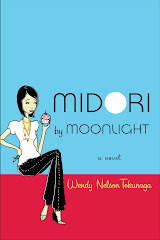
When I wanted the art department at my publisher to change Midori’s face on the original cover of Midori by Moonlight, I sent them three photos from the Ginza section and they did a great composite job of creating the face I had envisioned for her.

The pictures on TSS are all real people—not models—and show that everyone can have a great sense of style if they want to.

Thursday, August 13, 2009

NEW PEOPLE J-POP CENTER TO OPEN IN SF J-TOWN

The Internet continues to be all abuzz about the new J-pop Center dubbed New People that is having its grand opening this Saturday in San Francisco's Japantown (1746 Post Street). This mall will boast a cafe, boutiques, an art gallery, movie theater, and more. Here's a good article from my hometown paper, The San Francisco Chronicle, that gives a lot of the details. This is sure to be quite an extravaganza.

I won't be able to make the opening but I plan to go sometime on a weekday during the following week when things will be a little quieter. And hopefully, armed with my newish Canon pink PowerShot camera I'll be able to take some pictures and post them here.

Friday, July 31, 2009

heavenly BENTO


This looks like such a fascinating play. I wish I could be in New York to see it. Maybe it will come to San Francisco. heavenly BENTO tells the story of the epic journey of the founding of Sony by two friends who dream of reconstructing Japan after the country's devastation in the days following the end of World War II. The video gives you a taste of this unusual production that will be at the Post Theater September 17-19.

Monday, July 27, 2009

Chirashi Roundup


You can give me twenty lashes with a wet udon noodle if you wish, but I sure find it difficult to keep up with writing a blog with any amount of consistency. So I’m trying kind of a different format, which may allow me to post with a little more frequency.

I ran across this article in my hometown newspaper, The San Francisco Chronicle, which has some good tips for traveling on the cheap in Japan for those without any knowledge of Japanese. I love Shinjuku, but I’ve never been to Yakitori Alley so that was a new one on me.

And Mail Online offers up a very nice overview of Tokyo, my favorite city in the world (with San Francisco as a very close second and Manhattan as third). Many foreigners who travel or live in Japan are partial to Kyoto and while I like it there, I consider myself a Tokyo girl. Some nice photos here too.

And if you’re an otaku or just play one on TV, you’ll want to check out a review in The Japan Times on two new books: The Otaku Encyclopedia and Otaku: Japan’s Database Animals. Read more on the latter at the publisher’s site here.

Tuesday, June 30, 2009

Midori by Moonlight Book Trailer

I'm happy to present the Book Trailer for Midori by Moonlight, created by myself, with music composed by my husband Manabu Tokunaga.

Tuesday, June 23, 2009

Let's Cook Japanese Food!


I have finally found a Japanese cookbook that is as good as having my Japanese mother-in-law by my side in the kitchen. Amy Kaneko’s “Let’s Cook Japanese Food! Everyday Recipes for Home Cooking” (Chronicle Books) demystifies Japanese cooking and, most importantly for me, offers a number of recipes for “yoshoku” cuisine, those Western dishes the Japanese have borrowed from other cultures and made uniquely their own. These include mapo dofu (China), gratin (France), tempura (Portugal), and many more.

Japanese food means a lot of different things to different people, from gloppy teriyaki sauce dumped on steak to spider rolls on up to the pristine presentation of delicate small plates (kaiseki) that take years to master. But the dishes in “Let’s Cook Japanese Food!” are those you would encounter in a Japanese home or at an informal Japanese coffee shop restaurant in a department store. You’ll find many authentic favorites here, everything from Toriniku Kara-age (Fried Marinated Chicken) to Miso Soup to Omu Raisu (Omelet Stuffed with Tomatoey Chicken Rice) to my Japanese husband’s favorite, Okonomiyaki (“As-You-Like-It” Pancake).

Like me, Kaneko is an American who married into a Japanese family. Unlike me, she is a great cook and learned well from her mother-in-law and sister-in-law. Her easy-to-use cookbook has now turned me into a pretty decent Japanese cook. My Mapo Dofu (Chinese Style Spicy Tofu with Pork) and Sunomono (Cucumber and Shrimp Vinegared Salad) went over quite well with my husband last night. “Oishii!” he said. That means “delicious,” a comment that will make a cook from any country beam with pride.

Wednesday, June 10, 2009

Spaghetti With A Smile


I was at one of the Japanese markets in Silicon Valley the other day and bought a package of Mama’s Pronto Spaghetti. This pasta cooks in just five minutes and its apron-wearing housewife cartoon character proclaims, “Fine Quality, Fine Smile.” It was good to be assured that I wouldn’t be serving grouchy pasta to my husband.

When I showed him the package he did smile. “I haven’t eaten this spaghetti for so long,” he gushed, saying it made him “natsukashii” (nostalgic) for his childhood in Osaka.

This was the first time I’d bought Japanese spaghetti and the first time I made a type of wafu pasta—mushrooms and hijiki (seaweed) simmered in soy sauce and mirin (sweet rice wine) and a bit of sugar. But I have long been addicted to Japanese pasta, which somehow tastes different from any pasta I’ve ever eaten. In Japan, because it is a Western food, it is never served with chopsticks, but always with a fork and spoon. I have observed many Japanese women gracefully partaking their pasta by utilizing these two utensils, something this clumsy gaijin would never attempt.

Mama’s Pronto Spaghetti is made from durham wheat flour, like a lot of pasta. It seems to be thinner than regular spaghetti but not as thin as angel hair or spaghettini. Some Italian pasta is called “thin spaghetti,” and maybe it is close to this. I don’t know, but I do know that eating my humble attempt at wafu pasta also made me natsukashii for Japan.

Wednesday, June 3, 2009

Oh! A Mystery of Mono no Aware - by Todd Shimoda


Todd Shimoda’s latest novel, Oh!: A Mystery of Mono no Aware, published by Chin Music Press, is a fascinating and compelling book that weaves themes of both traditional and modern Japanese culture. You’ll be drawn in by Shimoda’s spare but elegant prose, which reminds me of the writing style of Haruki Murakami.

The protagonist of Oh!, Zack Hara, is dead inside, devoid of passion, hate, love, any sustained emotion. The twenty-something technical writer trudges through each day in LA like a zombie, until he leaves his job, part-time lover, and antique Chevy pickup truck to travel to Japan. There, searching for an emotional life, Zack becomes entwined with a tragic poet, a sensual but disillusioned woman, and young people who form suicide clubs –- all propelling him down a dangerous path.

Todd Shimoda, a third-generation Japanese-American, lives in Hawaii. He has published two other novels that deal with Japan and Japanese themes: 365 Views of Mt. Fuji (Stone Bridge Press) and The Fourth Treasure (Nan Talese/Doubleday). The books have been translated into six languages with over one hundred thousand copies printed worldwide. The Fourth Treasure was listed as a 2002 Notable Book by the Kiriyama Prize.

Oh! is not only a beautifully written novel, but the book itself is beautifully produced and includes artwork created by Todd’s wife, Linda Shimoda, an accomplished artist, illustrator and book designer, who is also the curator of the Kauai Museum in Hawaii. Her illustrations and artwork have appeared in both of Todd’s first two novels. In Oh!, her artwork offers clues to the fate of Zack Hara.

Todd was kind enough to take some time to answer some questions.

What was the inspiration for the novel? When did you first become aware of the term mono no aware?
I came across the Japanese aesthetic and poetic ideal of intense emotional reaction to things (mono no aware) when I was working on my novel The Fourth Treasure. I tried to write a non-fiction monograph about it, but couldn't capture the real feeling of the concept. I toyed with a fictional character trying to find an emotional life and how/if mono no aware could help him. I wrote a short story and as it often happens, that turned into a novel.

What fueled your interest in Japan’s suicide clubs?
It's a very tragic phenomenon which I first read about in a news story. I couldn't understand the whole idea of people meeting online and coming together to commit suicide. All sorts of questions haunted me: What do they talk about? How do they plan it? Why do it as a group? I tied it to the other plot ideas in Oh! as a way of showing the extreme actions people take to emotions.

Do you feel that your protagonist, Zack Hara, has anything in common with the hikikomori and otaku youth in Japan?
Despite Zack's lack of an emotional life, he enjoys being with people in a social way. This makes him different from hikikomori and otaku who I believe prefer not to interact with people. Or at least limit their face-to-face interactions.

What character in the novel do you relate to the most?
I mostly relate to the main character. Zack is about 5% autobiographical: I was a technical writer, we taught English in Japan, both our grandfathers came from Japan and worked in farming then landscaping, we watch way too much TV. As Zack does, I sometimes feel a little numb about life but not chronically and not to Zack's extent. But I'm closer in age to Professor Imai and can sometimes feel the weight of memories and the past as he does.

Your wife, Linda Shimoda, often illustrates your books. Can you describe your collaboration process?
We work separately for the most part. I tell her the basic elements of the story and she uses that framework to work her magic. She tells me what kind of art she is working on so I can incorporate it into the story. When I've finished a draft and she has her pieces ready, we look at each other's work. It's always amazing how well it jibes!

Have you formally studied Japanese? Are you continuing to study?
My nisei Dad never spoke Japanese so I never learned it. I lived in Japan in the mid 80s and studied it informally then. I never got much beyond a few phrases, kana, and some kanji. And now it's mostly gone I'm afraid.

According to your Web site you are working on two novels-in-progress. Do you work on them simultaneously? Are either being closed to finished/released?
Drafts of both Subduction and Why Ghosts Appear are finished and I'm revising them now. I worked on them at different times, a couple of years apart, but now am revising them and working on proposals simultaneously. I rarely do that (work on two novels at once) but I find it keeps me interested and fresher.

What is your favorite Japanese food and/or Japanese restaurant?
I'm mostly a veggie these days, so I'm a lover of tofu. Living in Hawaii (Kauai) I eat sashimi or fish maybe once a month, especially when I get a present of locally caught fish. Kintaro's is the best local Japanese restaurant. When I lived in San Francisco on Bush Street I loved Sushi Man, just down the block.

Visit Todd’s Web site here.

Thursday, May 28, 2009

Japanese Women Doing It for Themselves


Every so often an article such as this one from the Japan Times pops up telling us that women hold the true power in Japan despite what it may look like on the surface. Earlier this month a group of women entrepreneurs gathered together for the J300 Event in Tokyo put on by a firm that operates the JoseiShacho.net (Woman President) networking site.

The women participating numbered 360 and were from all over Japan; I wouldn’t be surprised if this constituted every female entrepreneur in the country. Statistics in the Japanese business world for women continue to be dismal: by 2007 the 160,000 Japanese women in managerial jobs represented only 9.2 percent of managers in Japan. Europe and the U.S. boast a percentage rate of around 30 percent, which still isn’t great, but leaps and bounds above Japan. Japanese women face old school traditions in Japan that are difficult to overcome. It is a place where there’s lots of lip service, but change happens at a snail’s pace.

Still, you have to admire the spirit of these women and hope they can succeed at spreading the word that Japanese companies just might be able to get out of their slump if they hire more women business managers. Women, they say, are better at understanding customer needs, which is imperative in making firms successful.

So, ladies, gambatte!

Tuesday, May 19, 2009

Hey, Baby, What's Your Blood Type?


I found it very strange the first time I was asked my blood type when I was in Japan. And my questioner’s shocked reaction seemed even stranger when I said I wasn’t sure. In Japan, not knowing your blood type is akin to not knowing your birthday.

The Associated Press
has reported that in 2008, four of the top-selling books in Japan concerned how blood type determines personality. Blood type in Japan is like horoscopes here (and they are popular in Japan as well). I do admit to believing in horoscopes, especially when they say something flattering about my personality or that a convergence of planets will bring good fortune to my bank account. And grouping peoples’ personalities by date of birth in roughly 30-day increments seems somewhat plausible, though I know there’s much more to it than that. But basing personality on only four blood types? That seems a bit farfetched.

In Japan dating agencies offer compatibility tests based on blood types and some kindergartners are even divided up in their classes based on B, A, O, or AB. Purchasers of condoms in vending machines can also choose according to their blood type. Prime Minister Aso saw fit to state on his official Internet profile that he is A. There is also a term for blood type harassment, bura-hara.

Now I find that there was a reason to feel a bit creepy about all this blood type business. Turns out Japan’s 1930s militarist government imported this theory from Nazi race ideology in order to breed better soldiers. This idea was later put to rest and the blood type craze went into decline until the 1970s when new books popped up promoting the theory as a way to foster one’s best talents and make for better relationships--much like horoscopes--instead of a way to judge or rank others.

The books that are so popular today claim that blood types are not definitive, and are only an indicator of personality tendencies. The practice, however, is so widespread that despite repeated warnings, many employers still will ask an applicant’s blood type during job interviews, oblivious that it could lead to discrimination.

Thursday, May 14, 2009

Promoting Japan's Pop Culture Arts


The Black Ship reports that Japan’s Cultural Affairs Agency will construct a 10,000-square meter art center in Tokyo that will promote Japanese manga, anime and game software. With an opening scheduled in two to three years, the hope is that the center will become a major tourist attraction for foreign visitors as well as a booster for the country’s pop art industries. No decision has been made yet on the location, but Odaiba is a possibility.

This announcement comes at the same time as the construction of the 20,000 square foot NEW PEOPLE destination spot building at 1746 Post Street (pictured) in San Francisco’s Japantown, which aims to celebrate, preserve and foster Japanese pop culture. I guess I have to be thankful that VIZ Media is headquartered in my hometown of San Francisco because this center could have easily popped up in Los Angeles or New York. It is the brainchild of Seiji Horibuchi, the VIZ CEO, and $15 million has been invested in it so far. The plan is to eventually expand globally.

NEW PEOPLE will include a cinema specializing in Japanese film, a cafe, various Harajuku-type shops, and an art gallery. It opens on August 15 and I can’t wait!

Sunday, May 10, 2009

Invasion of the Herbivorous Ladylike Japanese Man


Japan is a land of extreme trends and buzz words that can overtake the country in minutes and just as quickly disappear to make way for the next. But this is an interesting one and I think I even mentioned a reference to this syndrome in a previous post. The Japan Times documents a new trend that has culminated in a report from the Infinity market-research company called, “Herbivorous Ladylike Men Are Changing Japan” (Soshokukei Danshi Ojo-man Ga Nippon wo Kareu).


This new generation of Japanese men worry about their weight, are less competitive about careers, and are so close with their mothers that they take shopping trips together. The “ojo-man” (ladylike man) lacks any interest in dating young women or having any relationships; his sex life is limited to “self-help” toys and Internet porn. He is also fierce in his commitment to frugality and wouldn’t be caught dead without his coupons and frequent-shopper discount cards. Infinity claims that 60 percent of today’s Japanese men aged 20-34 fall into this category.

Exaggerated? Most probably. But ever since I first was in Japan I was struck by how there seemed to be no stigma against the gentler, more “feminine” man. I remember hearing complaints from Western women viewers of the Toni Collette movie Japanese Story (2003) such that they couldn’t understand the appeal of male lead Gotaro Tsunashima because he was “too feminine.” He was just a regular cute Japanese guy to me and I thought he was perfect for the role. The big, muscular, football player types that so many American women seem to go for never appealed to me. While Japan certainly has its more “masculine” movie and pop stars, there are certainly just as many ojo-men from which to choose.

Of course, sociologically, if this trend is true along with the trend of women purposely remaining unmarried and without kids, then the land of the rising sun is due to become a lot less crowded in the coming generations. But it could also point to a growing tolerance toward less strict gender roles for both sexes.

Thursday, May 7, 2009

Japanese Girls Gotta Rock


The Guardian reports on the predominance of women in the J-rock scene, which can seem paradoxical when thinking of the strict gender roles associated with Japan. As a female musician I was always struck by the abundance of women musicians and singers in the Japanese music business, even during the time when there was a dearth of women heard on American radio. To this day I’d say that the most popular performers are female and Japan was even one of the few to embrace that classic American all-girl band, The Runaways, who were pretty much ignored in the States.

The article goes on to say that Japan’s culture of karaoke is an important influence on female J-rock because of all the great female singers from before, thereby placing a high importance on vocal melodies. I couldn’t agree more. And maybe this partly explains my long attraction to J-pop and enka and my many favorites from the days of Akina Nakamori and Sayuri Ishikawa on up to Namie Amuro, Hikaru Utada, Ayumi Hamasaki and now Yui, whom I’ve just been introduced to by a number of fine J-pop bloggers.

I’m not ready to say that this pure freedom of expression we see in Japanese women pop and rockers is something that can change a society but, perhaps, little by little, they are contributing as empowering role models to other young women.

Monday, May 4, 2009

Crazy for Kanji


When I first started studying Japanese years ago, I became immersed in learning the written language, from hiragana and katakana (the phonetic language systems) to the actual characters—the kanji. And Celeste Duncan, the protagonist in my forthcoming novel, Love in Translation, also discovers an inexplicable connection to kanji once she finds herself in Tokyo.

No one, though, is as obsessed with kanji as Eve Kushner, a Berkeley-based freelance writer and blogger, who is a certifiable kanji addict. But instead of just sitting in her attic deconstructing kanji all day, she has channeled her obsession into an entertaining and delightful book called Crazy for Kanji: A Student’s Guide to the Wonderful World of Japanese Characters, published by Stone Bridge Press. Crazy for Kanji is filled with interesting facts, photos of kanji in action, cultural clues, games, puzzles and more.

Whether you are a serious student of Japanese or simply fascinated with these characters for both their beauty and practicality, you will find Crazy for Kanji a fun and engrossing read.

Eve stopped by to answer a few questions.

How did you become interested in kanji? Why Japanese? Why not Chinese characters, from which kanji developed?

I was forced to study several languages as a child, and I hated it (because I hate anything that I'm forced to do), but as an adult I've discovered that I love learning languages. In fact, the whole reason I started studying languages as an adult is that I went to hear the writer Rita Mae Brown speak at Black Oak Books in Berkeley. When a woman asked for advice on becoming a writer, Brown advised her to learn as many languages as possible, explaining that when you see connections between Latin, French, Spanish, Italian, English, and so forth, lights and bells will go off for you, and it will enrich your understanding of English immeasurably. After I heard that, I decided to study a different language every semester until I'd learned a little bit about 20 or 30 of them!

I studied Spanish for four years after that, and found that Rita Mae Brown was right. After Spanish, I tackled Japanese, because I'd felt fascinated with Japan since age 13, when I traveled to Japan and China with my family. We spent very little time in Japan and much more of the time in China. The contrast between the two was striking, because at that time (1981), Japan was quite advanced technologically (much more so than the United States), whereas China was definitely not. I fell in love with Old Japan—with the small bridges and gardens and all the daintiness of shoji screens and temples.

Then in college I took a course where we covered the "greatest hits" of Japanese and Chinese literature in 10 weeks, and it was the Japanese literature (Kawabata, Tanizaki, Mishima) that moved me in particular.

And then you moved on to formally studying Japanese?

Yes. In the late '90s, I discovered the now-defunct literary magazine Japanophile. I was trying to find my niche as a freelance writer, and they did eventually publish several of my articles. As I began to develop the idea of myself as a writer who covered Japanese topics, it became apparent that I should learn to speak the language.

When I started to tackle Japanese in 2001, I was hardly a natural at it, but I kept going. In our third course, we started kanji, and I hated every single bit of the way we learned it. I had no idea why we needed to write words with these complicated characters. Up till then, we'd written words phonetically, and I didn't understand why that was no longer enough. Again, because I felt forced to learn kanji without knowing why, I initially resented it. It didn't help that the teacher seemed to feel no affection for kanji at all. In Japan and elsewhere, kanji are so often treated as bitter medicine to "swallow" (via rote, joyless copying and memorization), and that was the feeling she passed on to us.

Then I came across a copy of Michael Rowley's Kanji Pict-o-Graphix, and everything changed for me. It's not that I responded to the graphic mnemonics; I'm not a very visual person, so I didn't even really see them. But he showed what each component in a character meant, and I found this fascinating. Little bits of meaning could add up to larger bits of meaning. I began making complex diagrams, where I noted the breakdowns of characters, taking these analyses further and further until I'd arrived at components that simply couldn't get any smaller. Because kanji utterly mystified me, I felt determined to study them down to their tiniest specks, thereby gaining some kind of control or mastery. (Ha! No such thing with kanji!)

And this turned into an obsession, which turned into love, and before I knew it, I came to love the very thing I used to hate!

How did Crazy for Kanji come to be published?

I met Peter Goodman, the publisher of Stone Bridge Press, in the late '90s when he was selling books at the Solano Stroll street festival in Berkeley. I fell in love with several of his books and with the whole idea of what he was doing. Soon after I met him, I profiled him for the East Bay Express and Japanophile. I also reviewed some of his books for various publications and we continued to keep in touch.

Friends who knew of my kanji obsession were always telling me I should write a book about kanji and I began to seriously think about it. I approached Peter and he told me to write up a proposal. Much to my delight, it intrigued him, and he instructed me to go in particular directions, such as explaining the basics of how kanji work and even writing about the use of characters in China, Korea, and Taiwan. After a lot of hard work, Crazy for Kanji came to fruition.

Do you have a favorite kanji?

I'm really crazy about 意—pronounced “i” (as ee, in English). For one thing, I think it's adorable. It reminds me of an upright animal, complete with a curving tail. I blogged about this at http://blogs.japanesepod101.com/?p=940, so the explanation and images there should give you a better idea of what I mean. Also, since 意 means "heart, mind, thought, meaning, sense," it factors into words about consciousness, intentions, thoughts, and feelings, all of which fascinate me.

What's up next for you on the kanji horizon?

I'll definitely keep blogging about kanji, and that occupies a huge amount of my life.

I'm less clear about my kanji explorations in the long term. As long as I keep blogging, I'll eventually cover many of the Joyo kanji (the approximately 2000 characters used in daily life in Japan). Without killing the spontaneity and fun I now feel whenever I investigate kanji, it might make sense to be more goal-oriented about covering the Joyo, so eventually I will have written essays about all of them, creating a kind of Joyo encyclopedia with essays on each character and its etymology and compounds.

And, last but not least, what is your favorite Japanese food?

I'm a tea addict, so I love green tea ice cream. When it's done right, it's tantalizingly full of possibilities. It seems to hint at something, but ... what? That "something" is always just around the corner, luring me on.

Be sure to visit Eve at her Web site and at her Kanji Curiosity blog. Eve is participating in a number of events in the San Francisco Bay Area throughout 2009, including appearances at the Asian Art Museum and the Soko Gakuen Language School in San Francisco. Get more details here.

Saturday, May 2, 2009

Japanese Sweet Tooth


LA.com reports on a new shop in Beverly Hills that’s set to give the cupcake phenomenon some competition. Fulfilled sells imagawayaki, a Japanese pastry often found in Japan at street fairs, which is traditionally filled with sweet adzuki beans. Japanese-American proprietor, Susumu Tsuchihashi, has turned this on its head by making imagawayaki with names like Karaoke Kitty and Harajuku Monkey and filling them with delights like white chocolate, nutella, and banana. A savory treat is the Spicy Samurai, filled with pepper jack cheese, cilantro, chicken apple sausage, and green chili.

These aren’t to be confused with the amazing crepes I first had in Harajuku back in the day and which have found their way to a few places in the U.S. When I mentioned imagawayaki to my husband he said that it was basically taiyaki, a pastry made to look like a fish that we’ve been able to get for years at May’s Coffee Shop in San Francisco’s Japantown. Downtown San Mateo also boasts its own post-modern taiyaki place called Sweet Breams, which specializes in chibi (mini) taiyaki.

I’m an o-manju girl myself, but I’d like to try this imagawayaki the next time I’m in LA—right after I finish downing a Sprinkles cupcake.

Wednesday, April 29, 2009

Manga Diplomacy


The Straits Times reports a rather cool development, with Japan’s Prime Minister utilizing “manga diplomacy” on his nascent state visit to Beijing to meet with Chinese Premier Wen Jiabao. Prior to his meeting with the premier, Aso met with Chinese students studying Japanese and also viewed the “Detective Conan” anime (pictured), which the students had helped dub into Mandarin. Apparently Aso has referred to himself as an otaku and a dai-fan of manga. He also met with the Chinese winner of an international manga contest he had set up in 2007 while in his role as foreign minister.

This also comes at the time where UPI Asia Online reports that Japan is hoping to increase tourism by 25 percent in 2010 and, hopefully, giving a boost to its economy. Part of the strategy will be to attract tourists who are interested in the country’s pop culture, including anime, games, and manga.

I think some enterprising gaijin living in Japan might be able to do some good business by hosting tours for foreigners interested in pop culture and making it easier to get around Japan. Take them to a J-pop concert, to Akihabara, and to Ghibli anime museum and the Osamu Tezuka manga museum.

I’ve never really been to Japan as a tourist and by the time I visited there (and eventually lived there) I had studied Japanese and knew a fair amount about the culture. People always ask me what it would be like to travel in Japan and, frankly, if you don’t know the language, I don’t think it would be very easy. Maybe that’s why Japan only currently gets a little over 8 million visitors annually. The country, with new campaigns in mind, would like to see that number reach 10 million by 2010 and 20 million by 2020.

Ganbatte, Nihon!